
Breast Implant Options
Breast Implant Options NJ & NYC
Choosing a breast implant involves more than selecting a size. Implant material, gel cohesivity, profile, projection, and placement can all influence how your breasts look and feel.
Dr. Joseph Racanelli offers a range of breast implant options for patients in New Jersey and New York City. While implants from multiple manufacturers are available, he most commonly uses the MENTOR® portfolio, including MemoryGel™, MemoryGel™ Xtra, and MemoryGel BOOST™, selecting each implant according to the patient’s anatomy and aesthetic goals.
Implant choices
SILICONE · SALINE · COHESIVE GEL
Custom approach
Type, size, profile, and placement tailored to you
Tri-state locations
New York City • Newark • Morristown
BREAST IMPLANT SELECTION
Which Breast Implants Does Dr. Racanelli Use?
Dr. Racanelli offers breast implants from leading manufacturers, allowing patients to consider a wide range of implant technologies, sizes, profiles, projections, and gel characteristics. MENTOR®, Motiva®, and MemoryGel™, MemoryGel™ Xtra, and MemoryGel BOOST™. His familiarity with the range allows him to select among different levels of softness, fullness, projection, and shape retention according to the individual patient's breast tissue and desired result.
Implant selection is not based on brand name or volume alone. Dr. Racanelli considers the patient's existing breast tissue, chest proportions, skin quality, breast asymmetry, and aesthetic goals when recommending an implant. The goal is not to choose one implant that is “best” for every patient, but to identify the implant characteristics best suited to the individual.

Implant Types
MENTOR® MemoryGel vs. MemoryGel Xtra vs. MemoryGel BOOST
MENTOR® offers several silicone gel breast implant options with different characteristics. Dr. Racanelli most commonly works with MemoryGel™, MemoryGel™ Xtra, and MemoryGel BOOST™. While all three are silicone breast implants, differences in gel, fill, projection, and shape retention allow the implant selection to be individualized to the patient's anatomy and desired result.
MENTOR® MemoryGel™
MemoryGel™ implants are designed to provide a soft, natural feel and are available in a broad range of sizes and profiles. They can be an excellent option for patients seeking natural-looking breast augmentation when additional implant firmness or shape retention is not necessary for the desired result.
MENTOR® MemoryGel™ Xtra
MemoryGel™ Xtra implants have a higher fill level than traditional MemoryGel implants, providing increased fullness while maintaining a soft feel. The additional fill can offer greater upper-pole fullness and projection for patients whose anatomy and aesthetic goals benefit from those characteristics.
MENTOR® MemoryGel BOOST™
MemoryGel BOOST™ implants use a highly cohesive gel and are designed for greater shape retention and projection. Their increased cohesivity can be particularly useful when Dr. Racanelli wants greater control over breast shape, fullness, or implant visibility and rippling in an appropriately selected patient.
Which MENTOR breast implant is best?
There is no single MENTOR breast implant that is best for every patient. MemoryGel, MemoryGel Xtra, and MemoryGel BOOST offer different combinations of softness, fullness, projection, and shape retention. Dr. Racanelli considers the patient's existing breast tissue, skin quality, chest proportions, asymmetry, and desired breast shape when determining which implant is most appropriate.
OTHER BREAST IMPLANT OPTIONS
Does Dr. Racanelli Offer Motiva® and Natrelle® Breast Implants?
Yes. Dr. Racanelli can offer breast implants from multiple manufacturers, including Motiva® and Natrelle®, in addition to the MENTOR® implants used most frequently in his practice. Patients who are interested in a particular implant brand are encouraged to discuss it during their breast augmentation consultation.
Implant brands differ in their available gel technologies, shell characteristics, sizes, profiles, and projections. Rather than recommending an implant based on brand recognition alone, Dr. Racanelli considers how those characteristics relate to the patient's anatomy and desired result.
Motiva® breast implants are available by special order for patients who prefer the Motiva implant system or when Dr. Racanelli believes a Motiva implant is appropriate for the surgical plan. Because Motiva implants are not routinely stocked in the practice, additional ordering costs may apply.
Ultimately, a patient's interest in a specific implant is part of the consultation, not a reason to exclude an option before she has been evaluated. Dr. Racanelli will discuss the advantages and limitations of the available implants and explain why he recommends a particular implant for that patient's body.

Real Patient - Dr. Racanelli
BREAST IMPLANT SIZING
How Do You Choose the Right Breast Implant Size?
Breast implant size is measured in cubic centimeters (cc), but cc alone does not determine how an implant will look on your body. Two implants with a similar volume can have different widths, profiles, and projections, and can create very different results.
Dr. Racanelli considers the patient's existing breast tissue, chest proportions, breast shape, skin envelope, asymmetry, and desired degree of fullness when developing the surgical plan. Rather than asking a patient to select an implant based on a number alone, the goal is to understand the look she wants and determine which implant dimensions can best create that result.
Final implant selection also incorporates intraoperative sizing. During surgery, Dr. Racanelli can evaluate implant sizers within the breast pocket and assess volume, projection, proportion, and symmetry before selecting the final implant.
Existing Breast Tissue
The amount and distribution of natural breast tissue can influence implant coverage, visibility, and the characteristics needed from the implant.
Chest & Breast Width
Implant width should complement the patient's individual anatomy rather than being selected from volume alone.
Profile
Profile describes how an implant's width relates to its forward projection and can significantly influence the final silhouette.
Projection
Implants with similar volumes can project differently from the chest, creating very different proportions and degrees of fullness.
Skin & Tissue Quality
Skin elasticity, tissue thickness, and the existing breast envelope help determine which implant characteristics may be most appropriate.
Existing Asymmetry
Differences in breast volume, inframammary folds, nipple position, or chest anatomy are considered when planning implant selection.
PROFILE & PROJECTION
Breast Implant Profile & Projection: What’s the Difference?
What Is Breast Implant Profile?
Breast implant profile describes the relationship between an implant’s width and how far it projects forward from the chest. Implants of similar volume can have different profiles, meaning the same number of cc’s can create a very different appearance.
A lower or moderate profile generally distributes volume across a wider base, while higher-profile implants concentrate more of the volume forward. The appropriate profile depends on the patient’s chest and breast dimensions, existing tissue, and desired shape, not simply how large she wants to be.
MENTOR® offers multiple profile options across its implant portfolio, giving Dr. Racanelli flexibility to match implant dimensions to the individual patient.
What Is Breast Implant Projection?
Projection refers to how far the implant extends forward from the chest wall. Greater projection can create more forward fullness without necessarily requiring a dramatically larger implant volume.
This is why choosing a breast implant based on cc’s alone can be misleading. Width, profile, projection, gel characteristics, and the patient’s existing breast tissue all work together to determine how an implant will actually look.
Dr. Racanelli considers these characteristics together when selecting an implant rather than treating any single measurement as the deciding factor.
BREAST ASYMMETRY
Can Different Breast Implants Improve Breast Asymmetry?
Asymmetry Before Surgery
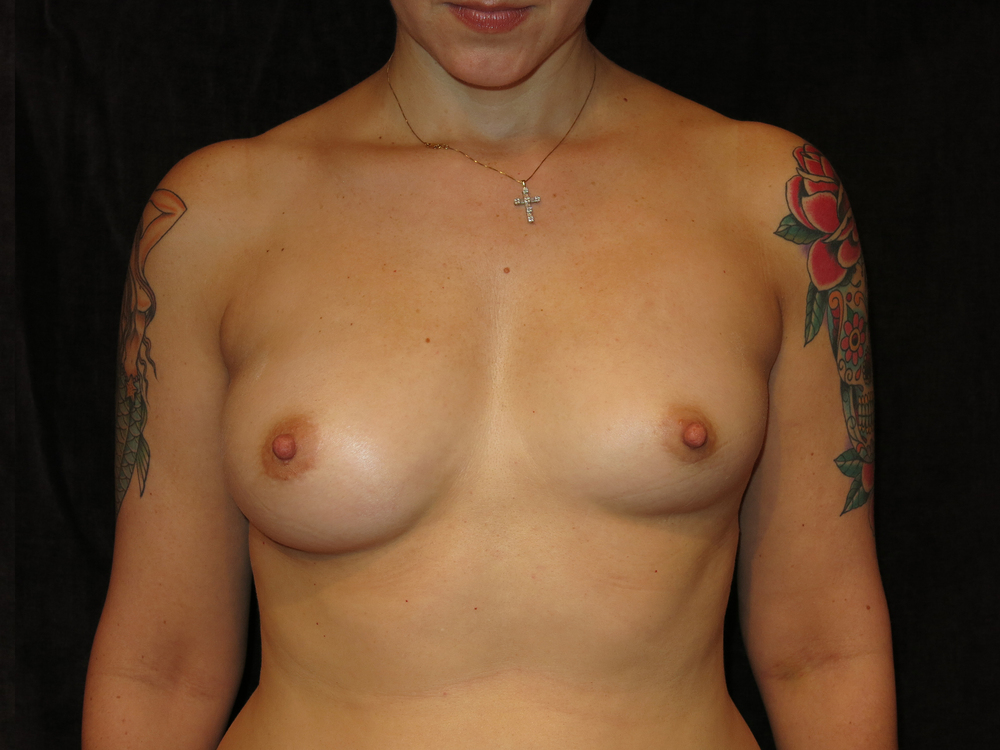
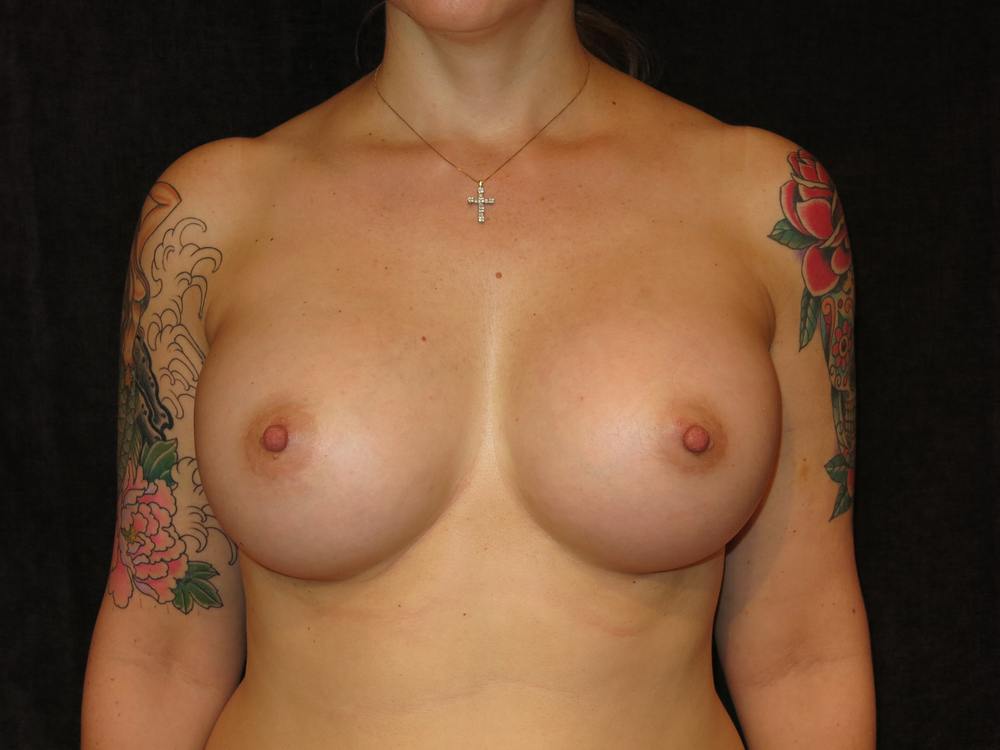
Some degree of breast asymmetry is extremely common. One breast may have more volume, a different shape, a higher or lower inframammary fold, or a different nipple position than the other.
During consultation, Dr. Racanelli evaluates these differences individually. Understanding where the asymmetry originates is important because not every difference can, or should, be addressed simply by changing implant size.
Using Different Implants
Different implant sizes, profiles, or projections may be used when appropriate to improve breast symmetry. For example, a patient with a meaningful difference in existing breast volume may benefit from different implants on the right and left sides.
The goal is improvement rather than mathematically perfect symmetry. Differences in the chest wall, breast envelope, inframammary folds, nipple position, and natural breast tissue may remain after surgery even when different implants are used.
Intraoperative Assessment
Dr. Racanelli evaluates breast shape and symmetry throughout surgery. After the implant pocket is created, temporary implant sizers can be used and the patient can be positioned upright so that volume, projection, breast shape, and symmetry can be assessed before the final implants are selected.
This allows implant selection to account for how the implants actually interact with the patient's anatomy rather than relying on a predetermined number of cc's alone.
IMPLANT PLACEMENT
Breast Implant Placement: Above or Below the Muscle?
Breast implants can be positioned above or below the pectoralis muscle, and implant placement can influence tissue coverage, breast shape, implant visibility, and the overall result. Dr. Racanelli generally prefers submuscular or dual-plane placement for breast augmentation, although the appropriate pocket ultimately depends on the patient's anatomy, existing breast tissue, implant selection, and aesthetic goals.
Submuscular / Dual-Plane Placement
With submuscular or dual-plane breast augmentation, the implant is placed at least partially beneath the pectoralis muscle. The additional tissue coverage can help soften the transition between the chest and implant, particularly in patients with less natural breast tissue.
This is Dr. Racanelli's preferred approach for most primary breast augmentation patients. The exact pocket is created according to the patient's anatomy and the implant being used rather than applying the same pocket design to every patient.
Subglandular / Above-the-Muscle Placement
With subglandular placement, the breast implant is positioned above the pectoralis muscle and beneath the natural breast tissue. This approach may be appropriate for selected patients who have sufficient natural tissue to provide implant coverage.
Above-the-muscle placement is not ideal for every patient. Tissue thickness, skin quality, implant characteristics, and the likelihood of visible implant edges or rippling are among the factors Dr. Racanelli considers before recommending this approach.
Is above or below the muscle better for breast implants?
Neither placement is universally better for every patient. Dr. Racanelli generally favors submuscular or dual-plane placement because of the additional implant coverage it can provide, but above-the-muscle placement may be appropriate in carefully selected patients with sufficient natural breast tissue.
A PERSONALIZED APPROACH
How Does Dr. Racanelli Choose Your Final Breast Implant?
Choosing a breast implant is not simply a matter of selecting a brand or deciding on a number of cc’s. Dr. Racanelli begins by understanding the patient’s desired result and evaluating her existing breast tissue, chest proportions, skin quality, breast shape, and asymmetry. Implant width, profile, projection, gel characteristics, and volume are then considered together to determine which options may best complement her anatomy.
The sizing process continues in the operating room. After creating the implant pocket, Dr. Racanelli uses temporary implant sizers to evaluate how different implant dimensions and volumes interact with the patient’s actual anatomy. The patient is positioned upright so that breast shape, projection, proportion, and right-to-left symmetry can be assessed before the final implants are selected.
Only after this assessment does Dr. Racanelli choose the final implant or implants. In patients with pre-existing breast asymmetry, this may include using different implant sizes or characteristics on each side when appropriate.
This is why the final breast implant is not determined by a single measurement or a predetermined number of cc’s before surgery. The goal is to select the implant that creates the most appropriate result for the individual patient, not to make the patient’s anatomy conform to a particular implant.

Real Patient - Dr. Racanelli
Do I need to know what breast implant size I want?
No. You do not need to know your ideal number of cc’s, profile, or even implant brand before your consultation. It is more helpful to communicate the shape, fullness, projection, and overall appearance you hope to achieve. Dr. Racanelli can then guide you through the implant options that are most appropriate for your anatomy and goals.
IMPLANT MATERIAL
Silicone vs. Saline Breast Implants: What’s the Difference?
Breast implants are generally filled with either silicone gel or sterile saline. Within silicone implants, the consistency and cohesivity of the gel can also vary, which is why terms such as “highly cohesive” and “gummy bear” are commonly used when discussing modern breast implant options.
Silicone Gel Breast Implants
Silicone breast implants contain a cohesive silicone gel designed to create a soft, natural feel. They are available in numerous sizes, profiles, projections, and levels of gel cohesivity, allowing the implant to be selected according to the patient's anatomy and desired result.
Silicone implants are the most commonly selected option among Dr. Racanelli's breast augmentation patients.
Saline Breast Implants
Saline implants have a silicone outer shell that is filled with sterile saline after the implant is placed. Because they are filled during surgery, their volume can be adjusted within the manufacturer's specified range.
Saline remains an available option for appropriate patients, although Dr. Racanelli more commonly uses silicone gel implants for primary breast augmentation.
What Are “Gummy Bear” Breast Implants?
“Gummy bear” is an informal term commonly used to describe breast implants containing a more cohesive silicone gel that is designed to maintain its shape. It does not necessarily mean the implant is teardrop-shaped. Highly cohesive silicone implants are available in different designs, including round implants.
MENTOR® MemoryGel BOOST™, for example, uses a more cohesive gel than traditional MemoryGel implants and is designed to provide greater shape retention and projection. Whether a more cohesive implant is advantageous depends on the patient's tissues, anatomy, and desired breast shape.
Is silicone or saline better for breast augmentation?
Neither implant is universally best for every patient. Silicone implants are more commonly used in Dr. Racanelli's practice because of the range of gel characteristics and implant options available, while saline may still be appropriate for selected patients. The choice should be based on the patient's anatomy, preferences, and surgical plan.
BREAST IMPLANT FAQ
Common Questions About Breast Implant Options
Which breast implant is best: MENTOR, Motiva, or Natrelle?
Does Dr. Racanelli offer Motiva breast implants?
What is the difference between MENTOR MemoryGel, MemoryGel Xtra, and MemoryGel BOOST?
How do I know what breast implant size is right for me?
Do I need to choose my exact implant size before surgery?
Can I use different-sized breast implants if my breasts are uneven?
Is it better to place breast implants above or below the muscle?
Neither placement is appropriate for every patient. Dr. Racanelli generally prefers submuscular or dual-plane placement for primary breast augmentation because of the additional tissue coverage it can provide. Above-the-muscle placement may be considered in selected patients with sufficient natural breast tissue and appropriate anatomy.
Do breast implants have to be replaced every 10 years?
No. Breast implants do not automatically need to be replaced simply because they reach 10 years. They are not considered lifetime devices, however, and additional surgery may eventually be necessary because of rupture, capsular contracture, changes in the breast, cosmetic preferences, or other concerns. Patients with silicone implants should also follow current FDA recommendations for rupture surveillance.
Can breast implants correct sagging breasts?
Why Patients Choose Dr. Racanelli for Breast Implant Surgery
Choosing the right breast implant is only one part of achieving a beautiful breast augmentation result. The surgeon's judgment, pocket creation, implant positioning, assessment of symmetry, and surgical technique all influence the final outcome.
Dr. Joseph Racanelli personally performs every step of each breast augmentation, from creating the implant pocket and evaluating intraoperative sizers to placing the final implants and completing the layered closure. His practice schedules one cosmetic surgery per day, allowing each procedure to receive his individual attention without moving between multiple elective cases.
Breast augmentation is performed under general anesthesia in a hospital operating room with a board-certified anesthesiologist. Dr. Racanelli's approach combines careful implant selection with individualized surgical planning based on each patient's anatomy, existing breast tissue, asymmetry, and aesthetic goals.
Breast implant consultations are available in New York City, Newark, and Morristown, serving patients throughout New York, New Jersey, and the surrounding metropolitan area.
Ready to Feel Like Yourself Again?
Your Breast Implant Consultation Starts With Your Goals
You don't need to know your ideal implant size, profile, or brand before your consultation. Dr. Racanelli will evaluate your anatomy, listen to the result you hope to achieve, and guide you through the breast implant options that may be appropriate for you.